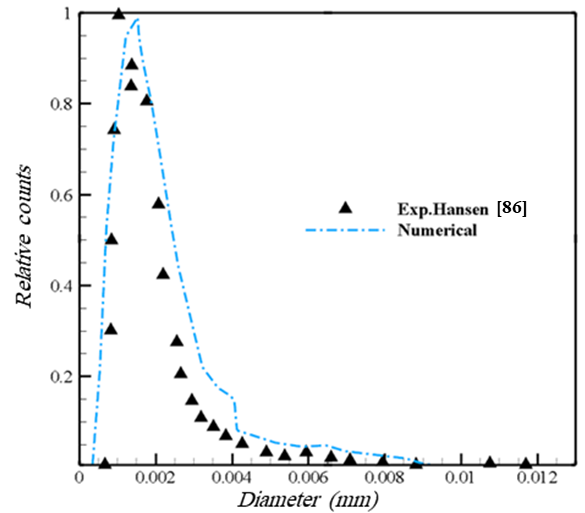
The breaking and joining of particles in OpenFOAM is based on compressible fluid dynamics and does not change by modifying the diameter or other characteristics of the particle by changing the pressure or temperature. To ensure the correctness of the joint and failure models, it is necessary to validate the models using an experimental sample. For this purpose, the flow inside a bubble column evaluated by Hansen in 2009 has been used. This column has a height of 0.45 meters and a length and width of 0.15 meters, inside which there is still water.
The gas distributor is installed in the center of the floor of this column along with 49 holes. Bubbles with an initial diameter of 4 mm are injected from each hole based on Dean's research. The apparent speed of air bubbles is 4.9 mm/s, and 3290 bubbles are injected into the column every second, and this work is done for 100 seconds.
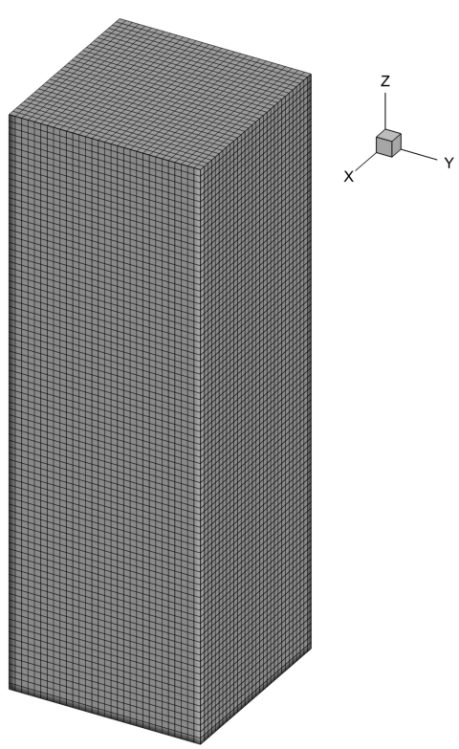
The k-ε turbulence model has been used to simulate the flow. According to the numerical research conducted by Hansen, a grid of 81,000 cells has been used, consisting of 30 grids along the length and width and 90 grids along the height of the column. Figure (1) shows a view of the used grid.
As can be seen in the experimental results, the bubble drops that entered the bubble column with a fixed diameter of 4 mm often break and decrease to an average diameter of 1 mm. The calculated experimental and numerical results have an error of 6%. The experimental droplet size distribution shows that drops up to 12 mm in diameter are formed in this case. Also, the minimum value obtained in the experimental mode is 0.7 mm.